Executive Summary
Aerospace maintenance is evolving fast. Netray’s custom AI agents are helping defense and commercial operators achieve 30–50% MTBF (Mean Time Between Failures) improvements across hydraulic systems, avionics, landing gear, and APUs.
By designing component-specific AI models—each trained on unique failure modes, stress patterns, and environmental data—organizations are reducing downtime, optimizing parts lifecycles, and unlocking over $2.3M in annual savings per aircraft.
Key Outcomes:
- 42% average MTBF increase
- 73% prediction accuracy
- 21-day deployment timeline
- Rapid ROI through reduced unplanned maintenance
The Aerospace Maintenance Challenge
Unplanned component failures cost the aerospace sector over $40 billion annually. Traditional predictive maintenance methods—built on generic algorithms—achieve only 15–25% accuracy.
Why? Because every aircraft system behaves differently. Hydraulic actuators endure high-pressure cycles; avionics face electromagnetic interference; landing gear absorbs shock loads. Treating them alike results in missed predictions and premature part replacements.
To fix this, Netray redefined predictive maintenance with AI agents specialized per component, combining machine learning with deep engineering context.
How Custom AI Agents Transform Maintenance
Netray’s Component-Specific AI Architecture replaces generic predictive models with intelligent agents trained on each system’s operational fingerprint.
Each agent continuously learns from flight data, sensor inputs, and maintenance logs, enabling real-time detection of anomalies such as seal wear, signal degradation, and vibration patterns.
Example:
A hydraulic AI agent trained on 847,000 operational cycles achieved 89% prediction accuracy—nearly three times higher than standard models—cutting downtime and maintenance costs by millions.
System-Level Intelligence in Action
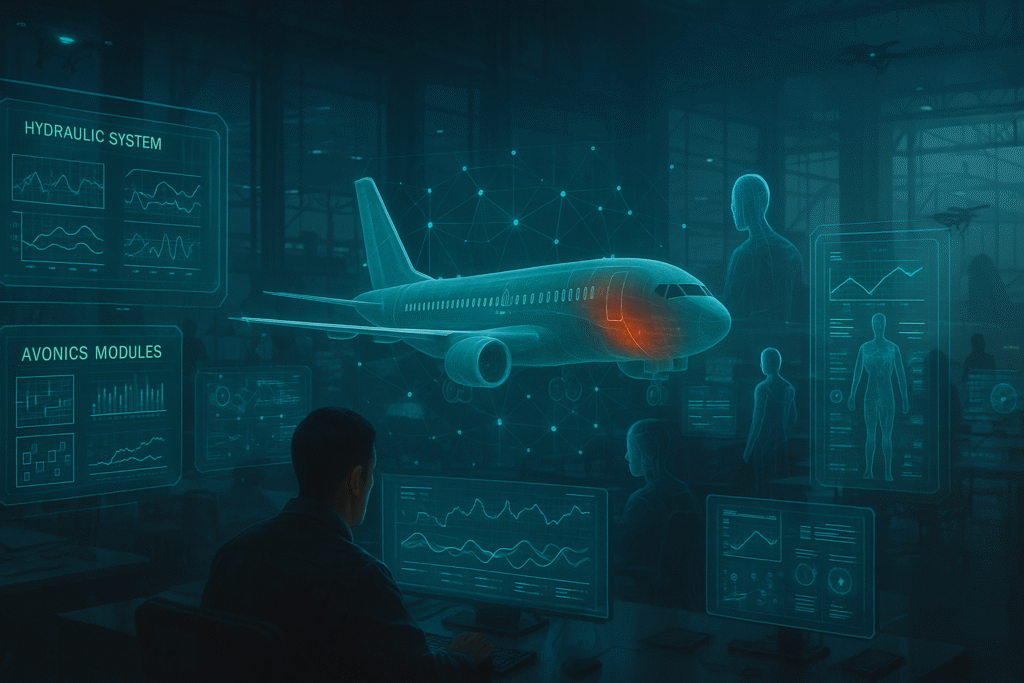
Hydraulic Systems: Detects micro-pressure anomalies and seal wear, achieving +45% MTBF improvement.
Avionics Suites: Tracks signal degradation and EMI sensitivity; reduces unexpected failures by 73%.
Landing Gear: Analyzes stress signatures and fatigue cycles, boosting reliability by 52%.
APU Systems: Monitors turbine temperatures and compressor efficiency for 33% longer service intervals.
Flight Controls & Engines: Uses actuator response and vibration analysis to extend life by 40–47
Netray’s Custom AI Development Framework
- Component Analysis & Data Design (Weeks 1–2)
Identify failure modes, operational limits, and flight parameters; establish the data architecture. - Model Design (Week 3)
Develop custom neural architectures aligned to each component’s physics of failure. - Training & Validation (Weeks 4–5)
Train on historical data, cross-validate across fleets, fine-tune for <10% false positives. - Integration & Deployment (Week 6)
Deploy into live CMMS/ERP environments with real-time dashboards and automated alerts.
Real-World Impact
A Tier-1 aerospace contractor managing 300+ suppliers cut maintenance costs by $3.2M annually and achieved 95% fleet-wide reliability gains using Netray’s framework.
A defense operator achieved full predictive coverage within 21 days—reducing unscheduled maintenance events by 43% and extending component lifespan fleet-wide.
Implementation Framework Essentials
- Automated data ingestion from flight logs and sensors
- Feature engineering customized to each system
- AI model management with continuous monitoring
- Smart alerts with severity-based escalation
- Native integrations with existing CMMS and ERP systems
Organizations typically achieve full ROI within 90 days of deployment.
What’s Next: Digital Twins & Explainable AI
The next evolution lies in digital twin integration and edge AI for on-aircraft monitoring. Soon, predictive systems will detect individual bearing fatigue or circuit degradation in real-time.
Emerging trends like federated learning and quantum-enhanced models will further enhance fleet-wide intelligence while preserving data privacy.
Business Value Snapshot
- 30–50% MTBF Improvement
- $2.3M Annual Cost Savings per Aircraft
- 75% Fewer Manual Maintenance Tasks
- 40% Faster Risk Detection
Conclusion: From Reactive to Predictive Readiness
The aerospace industry stands at a turning point. Component-specific AI is no longer an experiment—it’s a competitive advantage.
Netray’s AI agents enable real-time reliability intelligence, empowering operators to predict failures before they happen, minimize downtime, and elevate mission readiness.