The New Reality: Failure Is Not an Option
In aerospace and defense, even one component failure can mean lives lost, aborted missions, or billion-dollar setbacks.
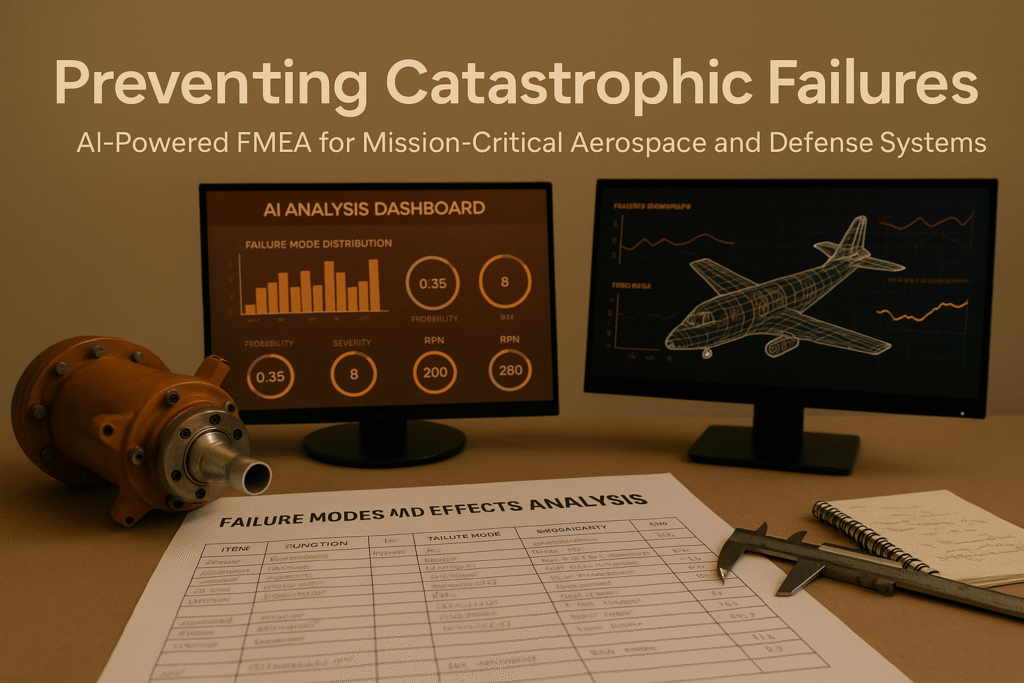
Traditional Failure Mode and Effects Analysis (FMEA) has safeguarded programs for decades — but today’s complex, software-driven systems have outgrown its limits.
Manual methods now miss ~40% of potential failure modes, while 73% of critical failures could have been predicted with better analysis.
Executive Summary
AI-driven FMEA enhances human analysis by learning from vast engineering data, identifying hidden risk patterns, and continuously adapting to new conditions.
Key Results:
- 65% more failure modes identified than manual FMEA
- 80% faster risk detection and intervention time
- 23% increase in system reliability
- Full MIL-STD-1629A, DO-178C, and AS9100 alignment
AI doesn’t replace safety engineering — it makes it faster, deeper, and predictive.
Where Traditional FMEA Breaks
Manual FMEA struggles because:
- Scale: Millions of code lines and components make exhaustive tracing impossible.
- Adaptivity: Systems change behavior mid-mission based on conditions.
- Interdependency: Cascading multi-system failures are missed when analyzed in isolation.
Modern platforms require intelligent systems that understand interaction, not just components.
How AI-Powered FMEA Works
- Pattern Recognition: Machine learning analyzes historical failures, maintenance data, and telemetry to predict new risks with >90% accuracy.
- Unsupervised Discovery: Finds unknown failure modes in satellite, propulsion, or avionics data that traditional reviews overlook.
- Deep Learning Context: Detects multi-variable failures (e.g., “thermal spike during high-G roll while INS drift active”) impossible to identify manually.
- Continuous Learning: AI agents update risk models in real time, reducing unexpected failures by 34%.
- Predictive Alerts: Warns operators 2–6 weeks before potential critical faults.
Result: a living, adaptive safety system — not static spreadsheets.
Real-World Results
Satellite Propulsion:
+37% more failure modes identified, preventing $400M in potential losses.
Fighter Flight Control:
Discovered GPS-jam-linked navigation risk missed by traditional analysis — 89% reduction in failure probability.
Launch Vehicle Engines:
23% more failure modes detected → 100% mission success across 12 launches.
Compliance-Ready Integration
AI-powered FMEA fully supports regulated aerospace workflows:
- Outputs align to MIL-STD-1629A structures
- Traceability ensures DO-178C / AS9100 acceptance
- Operates in secure, ITAR / DFARS-compliant environments
Every AI-generated risk is explainable, traceable, and audit-ready.
Quantified Impact
- 80% faster high-severity issue detection
- 65% broader safety coverage
- 30–50% fewer maintenance events
- 20–35% higher mission success rates
Aerospace safety is shifting from reactive review to predictive intelligence.
With AI-powered FMEA, programs can start small, prove results, and scale across fleets — turning static documentation into living, continuously learning safety systems.
Implementation Roadmap:
- Phase 1: Assess current FMEA depth and data quality.
- Phase 2: Pilot AI on one critical subsystem to benchmark accuracy.
- Phase 3: Scale organization-wide and automate real-time updates.
This approach unites predictive analytics, digital twins, autonomous mitigation, and federated learning, creating self-improving safety frameworks.
Traditional FMEA can’t match that pace — but AI can.
Bottom line:
Organizations that adopt AI-driven FMEA now will lead in reliability, certification confidence, and mission assurance.
Start with one subsystem. Prove it. Scale it. Lead the future of aerospace safety.